

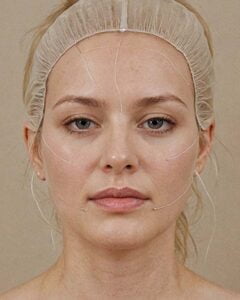
In medical practice dissolvable threads are used not only in surgery but also in aesthetic medicine. In classical surgery, threads or dissolvable sutures can be used as means of closing an open wound. In aesthetic medicine, face lifting threads are used to create tension and lift – but how long threads dissolve and are they completely safe to use? If you are interested in this topic, please read on – we explain why this method is so popular.
Dissolvable threads – how long do they take to dissolve in the body?
Dissolvable sutures are an extremely popular method of closing wounds after procedures or mechanical damage. Depending on the thread, they dissolve after approx. 6-18 months, but more on that later.
The material from which threads are made is often the same, but the engineering is completely different. While both, surgical and aesthetic threads use Polydioxanone (PDO), think of surgical sutures as “structural glue” meant to hold a wound shut, whereas aesthetic threads are “scaffolding” designed to manipulate skin and trigger a biological response in a PDO Thread Lift.
Do they look different?
Yes, significantly. Unlike the smooth threads used in hospitals to close a wound, aesthetic PDO threads often have microscopic features designed to lift:
- They are not just smooth: High-end lifting threads contain tiny barbs, cogs, or cones.
- The “Velcro” Effect: These tiny structures act like velcro beneath the skin. They gently hook into the sagging tissue, allowing the doctor to physically lift the skin upwards to restore a youthful V-shape.
While a surgical suture is typically a smooth, uniform strand, aesthetic threads are physically modified to interact with facial tissue:
- Surgical Sutures: Generally smooth monofilaments. They are designed to glide through tissue with minimal friction so the surgeon can tie a knot easily.
- Aesthetic “Cog” or “Barbed” Threads: These have tiny, microscopic hooks (barbs) or “cogs” along the strand. These barbs act like umbrellas; they open up once inserted to “grab” the fat and skin, allowing the provider to physically pull and lift the face.
- Aesthetic “Screw” or “Twist” Threads: These are coiled like a spring. They don’t lift, but they provide more surface area to stimulate collagen, “filling” a wrinkle or a hollow area from the inside out.
Is there a difference in how they dissolve?
The biological process—hydrolysis—is the same. Your body uses water to break down the polymer and eventually excretes it. However, the intent of the dissolution differs:
- In Surgery: The goal is for the thread to remain strong until the wound has healed itself (usually a few weeks to months). Once the body’s natural scar tissue is strong enough, the thread is no longer needed.
- In Aesthetics: The “controlled injury” of the thread dissolving is the main event. As the thread breaks down over 6–9 months, it creates a “collagen scaffold.” Even after the thread is 100% gone, the new collagen remains, keeping the skin firm for another 6–12 months.
Does thickness or material change the “melt” time?
Absolutely. The rate of absorption is a calculation of volume vs. surface area.
- Thickness (Gauge): A thicker thread (lower gauge number) contains more material and takes longer for the body to break down. Thicker threads are used for heavy lifting (like the jawline), while ultra-thin threads are used for delicate areas (like under the eyes).
- The “Material” Factor: While PDO is the “standard,” aesthetic medicine also uses two other materials that last much longer:
- PLLA (Poly-L-Lactic Acid): Lasts ~12 to 18 months. It is a powerful “volumizer.”
- PCL (Polycaprolactone): The “heavy hitter.” It can take up to 2 years to dissolve, providing the longest-lasting results.
Summary Comparison Table
| Feature | Surgical PDO Suture | Aesthetic PDO Thread |
| Surface | Smooth (monofilament) | Barbed, Cogged, or Coiled |
| Primary Goal | Wound closure / Healing | Lifting & Collagen stimulation |
| Anchoring | Tied in a knot | Anchored by barbs in the tissue |
| Duration | Dissolves once wound is stable | Dissolves to trigger long-term collagen |
What Do Dissolvable Aesthetic Threads Actually Look Like? (The PDO Thread Lift Explained)
What do dissolvable stitches look like? While many people search for dissolvable sutures to understand how wounds close/heal after surgery, there is a revolutionary application for these threads that goes beyond just closing cuts. In the world of aesthetic medicine, these same safe, medical-grade threads are the secret behind the non-surgical face lift.
They may look similar to regular non-dissolvable stitches – they are simply threads that pass through the skin. Are you wondering how to recognize dissolvable stitches? The type of suture can often be identified by its color: dissolvable sutures are often clear or have a natural, “leathery” color, while insoluble sutures are usually blue, black or white.
If you are wondering “what do dissolvable stitches look like” because you are considering a cosmetic treatment to lift sagging skin, you are looking for PDO Threads.
To the naked eye, a PDO thread looks like a fine, translucent fishing line. However, under a microscope, their design reveals their function:
- Mono Threads (Smooth): These look like short, smooth hairs. They are placed in a mesh-like pattern to tighten skin and treat fine lines but do not provide a heavy lift.
- Cog/Barb Threads: These look like a stem with tiny thorns. These “thorns” open up under the skin to grip and lift heavy tissues like jowls or nasolabial folds.
- Screw/Twisted Threads: These look like a coiled spring. They are used to give volume to sunken areas, such as deep wrinkles.
Call our reception today to book your consultation.
How Long Do Threads Dissolve? (The Dual Benefit)
One of the most common questions we hear is: “If the threads dissolve, does the lift disappear?”
The answer is no. The beauty of the PDO thread lift lies in its dual action:
- Immediate Mechanical Lift (Months 0–6): The threads physically hold your skin in its new, lifted position. During this time, the threads are slowly breaking down (hydrolysis). Most dissolvable stitches in aesthetic medicine disappear completely within 6 to 9 months.
- Biological Lift (Months 6–18+): This is the “magic” phase. As the thread dissolves, your body treats it as a mild “injury” and rushes to repair it. It builds a tunnel of new collagen and elastin around the thread. Even after the thread is gone, this newly formed collagen structure remains, keeping your skin firm and tight for up to 18 months or more.
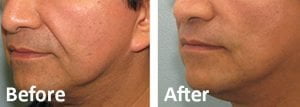
Click the Before and After Image to Read more about PDO Threads:
Why Choose Threads Over Surgery?
While a surgical facelift involves cutting skin and permanent sutures, a thread lift offers a minimal downtime alternative.
- No Scars: The threads are inserted via a tiny needle, leaving no visible scarring.
- Natural Results: Because it uses your own collagen, the result is a fresher version of you, not a “wind-blown” plastic look.
- Safety: Since PDO threads are fully biodegradable, the risk of long-term complications is significantly lower than with permanent implants.
Self-dissolving sutures are made of materials that gradually dissolve in the body. This means they don’t need to be removed by a doctor – they just disappear after a while. Therefore, the patient does not have to use the services of a surgeon again – so it is no wonder that solutions such as dissolvable sutures are being used more and more often. How long does it take for them to dissolve? The truth is that this time can vary depending on many factors!
Enter your phone number and our consultant will call you back …
Dissolvable stitches – how long does the body need to get rid of them?
We already know how useful dissolvable sutures are. How long does our body need to absorb them? This aspect depends on many factors. This is influenced by, among others, the type of suture, type of surgery, and even the specificity of a given organism. Generally speaking, most dissolvable stitches will begin to disappear after 1-2 weeks and will be completely gone after about 6-18 months.
Is it possible to recognize dissolvable stitches on your own? Although such decisions are better left to specialists employed by the aesthetic medicine clinic in London, there are a few tips that may help. As previously mentioned, we can often rely on the color of the thread. Moreover, if after a few weeks the stitches do not cause pain and there is almost no trace of them, the probability that they are dissolvable stitches is very high.
Even though dissolvable sutures are being used more and more often, they are not always the best option. It all depends on the type of surgery, the location and size of the wound, as well as the preferences of the patient and the surgeon. In some cases, specialists may decide that traditional non-dissolving sutures are better. Most dissolvable stitches will disappear completely, but in some cases small fragments may remain and these will also disappear over time.
Do dissolvable stitches hurt?
Pain sensations associated with dissolvable stitches may vary depending on the person and the location of the wound, but they usually do not cause severe pain. If you have dissolvable stitches, it is worth waiting a few days before bathing – it is necessary to make sure that the wound is well closed.
Due to their many advantages, such as comfort and lower risk of infection, dissolvable sutures are becoming more and more popular around the world. Remember that you should obtain any recommendations regarding postoperative wound care directly from your doctor. If you care about the best care, our clinic in London, Rickmansworth, Maple Cross recommends its services!
How to Accelerate the Dissolution of PDO Threads
As specialists in Polydioxanone (PDO) thread lifting, the team at Eskulap Clinic understands that while these treatments provide exceptional facial contouring, certain situations may arise where a patient wishes to speed up the absorption process. Whether you are looking to refine your aesthetic results or address unexpected side effects, several professional methods can facilitate a faster breakdown of the sutures.
-
Professional Medical Guidance
Before attempting to alter your results, a consultation with a certified expert is mandatory. Dr Kisiel at Eskulap Clinic is your expert to evaluate your specific anatomy and concerns to create a safe, personalized strategy.
-
Enzyme Injections (Hyaluronidase)
Hyaluronidase is a specialized enzyme frequently used to dissolve hyaluronic acid-based fillers, but it can also assist in the breakdown of PDO materials. When precisely injected into the treatment zone, it can help catalyze the dissolution process.
-
Manual Massage
Targeted, gentle massage can improve local microcirculation, which encourages the body to metabolize the foreign thread material more efficiently. However, improper technique can lead to tissue irritation. Our medical staff can demonstrate the correct pressure and movements required to support thread breakdown without causing trauma to the skin.
-
Thermal and Energy-Based Therapies
Applying controlled heat can significantly increase metabolic activity and blood flow in the treated area, speeding up the absorption of the PDO material. This can be achieved through simple warm compresses at home or professional in-office treatments like Radiofrequency (RF) or laser therapy. We can help you determine which heat-based modality is safest for your skin type.
-
Specialized Topical Regimens
Using medical-grade topicals containing Alpha Hydroxy Acids (AHAs) or Retinoids can improve cellular turnover. While these won’t “melt” the thread directly, they support the skin’s regenerative environment. Always consult with a professional before starting these to ensure they won’t irritate the insertion points.
-
Metabolic and Lifestyle Support
Your body’s natural ability to process the threads is linked to your overall health. Staying hydrated, maintaining a nutrient-dense diet, and avoiding toxins like tobacco or excessive sun exposure can optimize your metabolic rate, allowing your immune system to break down the sutures as intended.
The Complexity of Thread Removal
It is vital to understand that while PDO threads are designed to be absorbed, attempting to force this process too quickly can lead to complications if not managed by an expert. The more intricate the case, the more crucial it is to work with a practitioner who has a deep understanding of thread chemistry.
What are APTOS Threads?
APTOS threads represent a highly specialized category in aesthetic medicine. Developed by plastic surgeons in the late 1990s, APTOS (short for “Anti-Ptosis”) threads are often considered the “gold standard” for non-surgical lifting because of their unique chemical composition and aggressive anchoring design.
APTOS Threads?
Unlike standard PDO threads that last about 6-12 months, APTOS threads are typically made of a patented blend of Poly-L-lactic acid (PLLA) and Polycaprolactone (PCL).
-
The Material Advantage: PCL is the “heavy hitter” of materials. By combining it with PLLA, APTOS threads provide a dual-action benefit: they provide an immediate mechanical lift while slowly releasing lactic acid, which acts as a powerful biostimulator to regenerate collagen.
-
Longevity: Because of this PLLA/PCL blend, APTOS threads take much longer to dissolve than PDO—often remaining in the tissue for 1.5 to 2 years. The resulting collagen “scaffold” can keep the face lifted for up to 3 years.
Key Differentiators
Based on the engineering and anchoring, APTOS threads stand out in several ways:
| Feature | PDO Threads | APTOS Threads |
| Material | Polydioxanone (PDO) | PLLA + Polycaprolactone (PCL) |
| Barb Design | Microscopic “thorns” or cogs | Multidirectional, specially shaped “notches” |
| Dissolution | 6–9 months | 18–24 months |
| Lifting Power | Light to Moderate | High (comparable to “mini” surgical lifts) |
The “Universal” Application
A unique aspect of APTOS is the variety of their “architectural” designs. While Mono, Cog, and Screw threads are popular, APTOS expands this with specialized kits like the “Visage” for mid-face lifting or “Needle Method” for the neck. These threads are often longer and feature multidirectional barbs, allowing a doctor to “weave” the thread through the tissue to create a much stronger anchor than a simple straight PDO barb could provide.
Safety and Evolution
Much like the dissolvable sutures, APTOS threads are fully bio-absorbable and disappear through hydrolysis. They have evolved from permanent polypropylene (non-dissolvable) to the modern absorbable versions used today, balancing the safety of a “vanishing” thread with the durability of a long-term surgical result.
What are Silhouette Threads? (PLA)
Unlike PDO, Silhouette threads are crafted from Polylactic Acid (PLA). These are biocompatible, dissolvable sutures designed to provide a “dual-action” lift. They utilize small, bi-directional cones that anchor into the subcutaneous fat to pull sagging skin upward, specifically targeting the cheeks and jawline.
Material Composition and Safety
PLA is a synthetic polymer sourced from renewable materials like corn starch. It has a long history of safe use in surgical implants. As Silhouette threads degrade, they break down into lactic acid—a substance your body naturally metabolizes and clears without leaving any toxic residue.
The Lifecycle of Silhouette Threads
The absorption of PLA threads is a slower process, typically taking 12 to 18 months. During this time, they act as a “biostimulator,” triggering the production of Type I and Type III collagen. This means that as the physical thread vanishes, a natural structural matrix of collagen takes its place, ensuring the lift remains visible long after the suture has dissolved.
Factors Influencing PDO Dissolving Time
The speed at which Polydioxanone is absorbed depends on several biological and physical variables:
- Thread Caliber: Thicker, barbed threads take longer to break down than thin mono threads.
- Movement Levels: Threads placed in highly active areas (like the mouth or “marionette” lines) tend to degrade faster due to mechanical friction.
- Metabolic Rate: Younger patients or those with higher physical activity levels often absorb threads more rapidly.
- Lifestyle: High stress, smoking, and alcohol consumption can actually hinder the body’s natural healing and absorption efficiency.
Summary: Managing Your Expectations
While most patients see their peak results between 6 and 8 months, the process is gradual. It is common to feel the threads or see slight irregularities as they begin to soften; these are typically temporary.
Key Takeaways:
- Minimally Invasive: Thread lifts offer significant rejuvenation without the scars of surgery.
- Natural Breakdown: Absorption happens through hydrolysis, turning the thread into water and carbon dioxide.
- Collagen is the Goal: For the best results, you actually want the threads to stay long enough to build a strong collagen foundation.
- Expert Care: Always choose a provider who uses high-quality products, such as V Soft Lift, to ensure the safest and most predictable dissolution.
Eskulap Aesthetic Medicine Clinic in London Greenford and Maple Cross Rickmansworth
To submit your Google Review, click the Star 
Homepage:
Media:
Treatments:
Treatments for face:
Treatments for body:
Cost of treatments:
Call our Clinic to book you assessment today 07747474755
Social media
Instargram:
https://www.instagram.com/eskulap.clinic/
Facebook:
https://www.facebook.com/polskaklinika
Twitter:
https://twitter.com/polskaklinika/
LinkedIn:
https://uk.linkedin.com/company/eskulap-clinic-london
YouTube:
https://www.youtube.com/channel/UCnjXp2zHp55B-gbIxAqXkpQ